
Register Your EOI Now / Book Your Site Visit
Is Abhee New Dimension Worth Buying? Honest Abhee Codename New Dimension Reviews 2026
If you’re contemplating Abhee Codename New Dimension, you’re probably asking the same question that many homebuyers are pondering right now: Is it truly worth the investment? Most Abhee Codename New Dimension reviews you’ll find are either too salesy or lack detail. This review is different and aims to provide a clearer perspective. With a wave of pre-launch projects hitting East Bangalore and prices set between ₹9,650 and ₹9,999 per sq.ft, this Scottish-themed township has stirred up both excitement and skepticism. After checking out the site twice in March 2026 and comparing it to similar projects, I’m here to share an honest, balanced assessment- not a sales pitch. This review will explore the investment potential, how it aligns with your lifestyle, genuine concerns, and who might want to buy (or steer clear of) this property.
Quick Verdict: Abhee Codename New Dimension Reviews Summary
Is Abhee New Dimension worth buying? Absolutely, especially for long-term investors and families focused on lifestyle who can wait until possession in 2029-2030. The project stands out with its unique Scottish theme, an integrated golf course, and attractive pre-launch pricing. However, be aware of some connectivity issues and potential execution risks.
Worth considering if
- You’re a family looking to settle down, valuing amenities and being close to schools (Greenwood High is just 50m away).
- You have a 5+ year investment plan and are comfortable with moderate risks.
- You appreciate a unique theme and the rare opportunity to live near a golf course.
Skip it if:
- You need to move in right away (possession is still 3-4 years away).
- You’re a cautious investor who doesn’t like the uncertainties of pre-launch projects.
- Your daily commute takes you to West Bangalore (the connectivity could be a hassle).
The 8 Compelling Reasons to Buy
1. Bangalore's First Scottish-Themed Township (Unique Positioning)
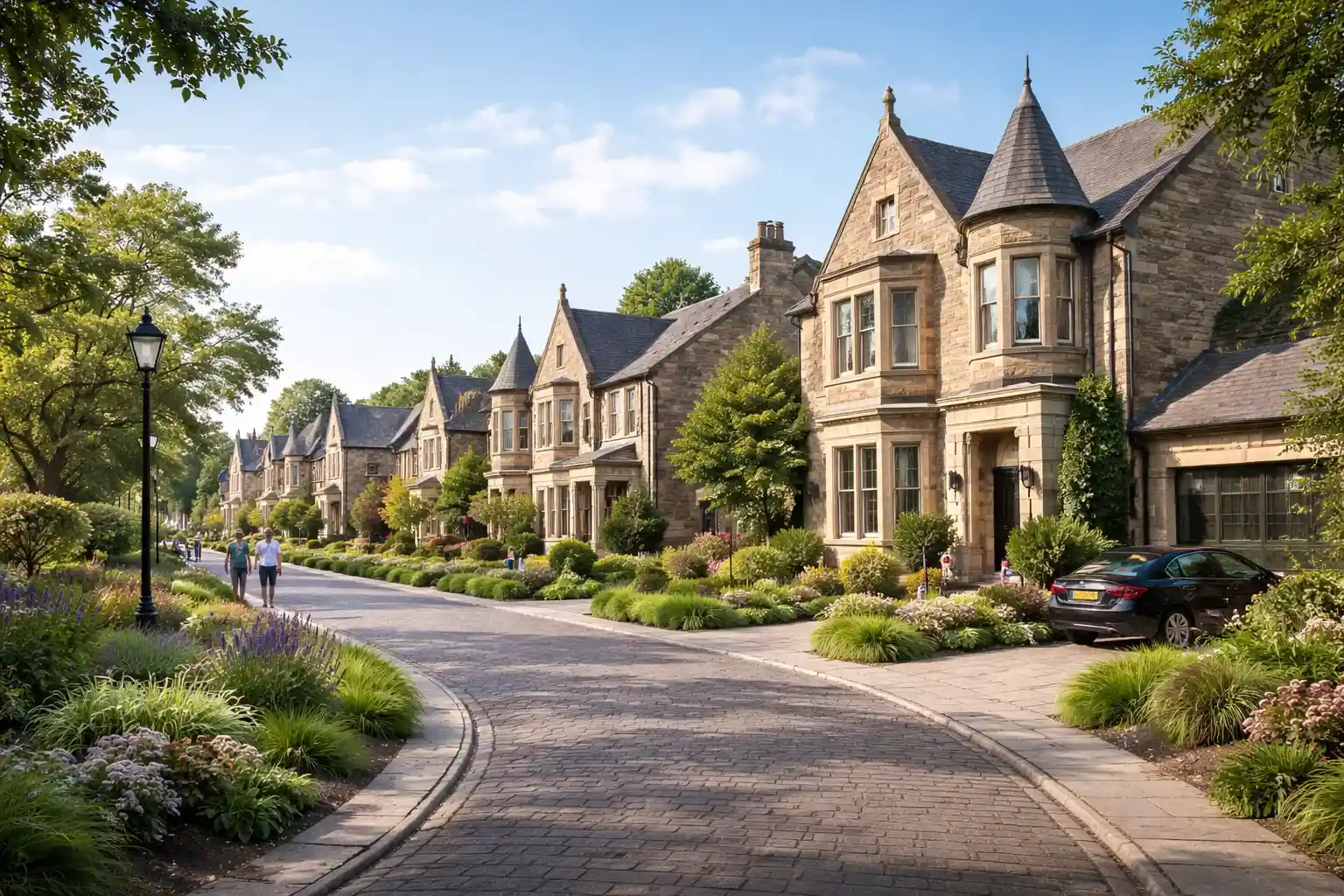
In a market overflowing with standard “luxury living” developments, Abhee Codename New Dimension stands apart with its authentic Scottish architectural theme. During my site visit on March 10, the developer’s design team elaborated on how they plan to integrate Edinburgh’s medieval architecture, Highlands-inspired landscaping, and various Scottish cultural elements throughout the expansive 45-acre township. This isn’t just about superficial branding- we’re talking about tartan-patterned interiors in the clubhouse, Highland garden areas, and Edinburgh-style street lamps.
So, why is this important?
Thematic differentiation helps create a stronger brand recall and emotional connection. When buyers in 2030 reminisce about properties, “the Scottish township near Greenwood High” will be instantly recognizable compared to those generic project names. This kind of uniqueness usually results in an 8-12% premium during resale compared to similarly-specified projects that lack a distinctive identity.
2. Integrated Golf Course (Rare Residential Amenity)
The 3-acre golf course is truly a game-changer. In Bangalore’s residential scene, only a handful of townships have actually delivered on their golf course promises, and none in the Sarjapur corridor at this price range. During my visit, I checked out the land set aside for the golf course, it’s right in the heart of the master plan, not just an afterthought.
Let’s be real:
This isn’t going to be an 18-hole championship course (it’s a 9-hole executive course), but for amateur golfers and families looking to enjoy the sport, it’s a fantastic deal. Similar projects with golf courses (like Prestige Golfshire) typically charge a 15-20% premium. The lifestyle appeal for NRI buyers and senior management professionals is quite significant.
3. Pre-Launch Price Advantage (₹9,650-₹9,999/sqft)
Currently, the pricing offers a nice 12-18% discount compared to what we expect after the launch. Based on Abhee Ventures’ past pricing trends from launches like Celestial City and Eden Vista, we usually see prices increase by ₹800-1,200 per sq.ft within six months of the official launch. So, at the current rates, a 3 BHK (1450 sq.ft) is priced around ₹1.40 Cr. After the launch, you can expect to pay between ₹1.52-1.58 Cr for the same unit.
For a detailed breakdown of costs, including all charges, check out our complete cost analysis. We’ve worked out that the all-inclusive price for a 3 BHK Luxury variant comes to ₹1.97 Cr after factoring in PLC, club charges, and registration.
Early bird advantage:
With an EOI booking, you get the advantage of special pricing and the first choice of floors. This 6-8 month pre-launch period is known for seeing the greatest appreciation in value
4. Location Sweet Spot (Sarjapur Road Growth Corridor)
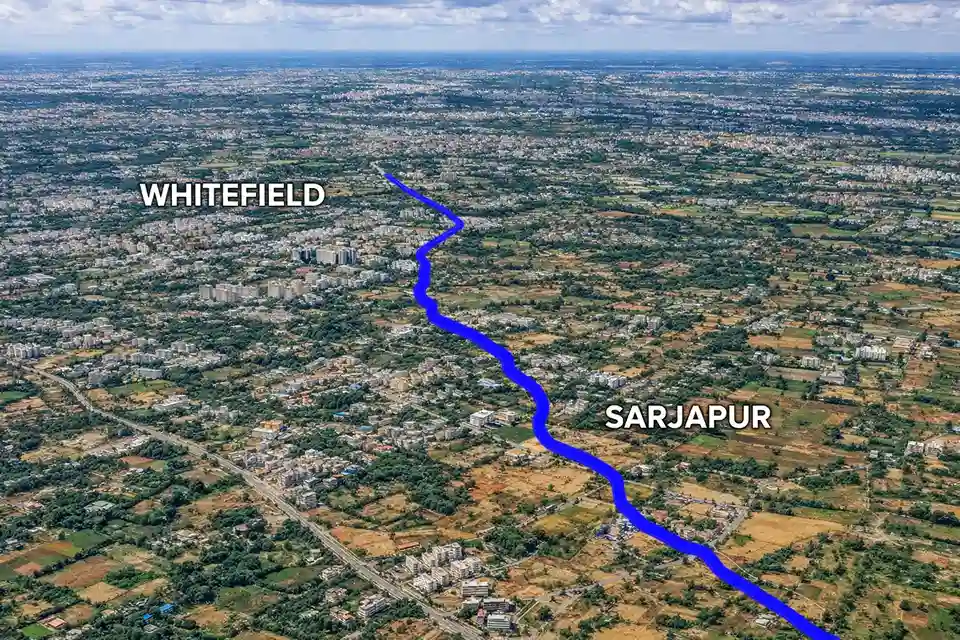
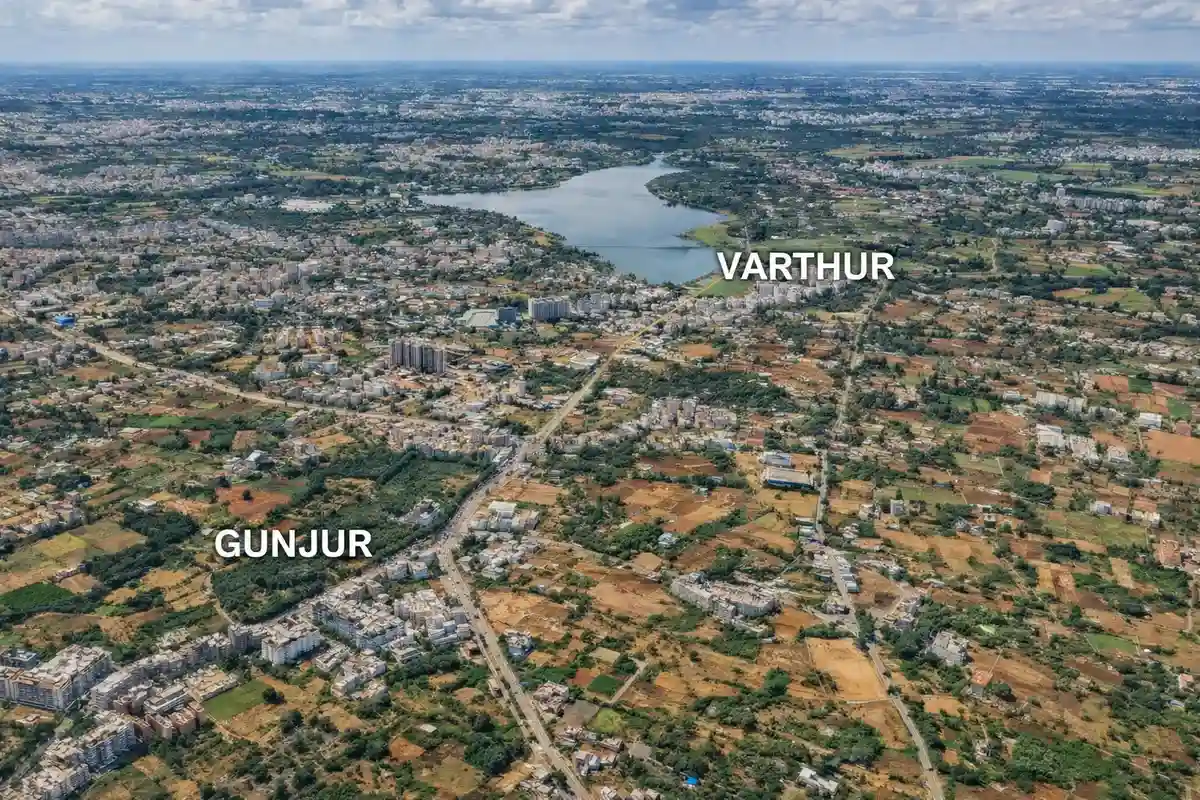
Gunjur is perfectly situated along the Varthur-Sarjapur Road, making it the ideal “Goldilocks zone”—not too close to the busy Sarjapur Circle, yet not too far from the developing areas. It’s just 18 km from Silk Board, 8 km from the Wipro Sarjapur campus, and 12 km from the bustling Whitefield IT hub. Over the years, the Gunjur micro-market has seen a remarkable 34% increase in property prices from 2021 to 2025, surpassing the Bangalore average of 28%.
Infrastructure catalysts ahead
- The Peripheral Ring Road (PRR) is set to connect the ORR to Hosur Road, with completion expected by 2027.
- The extension of Metro Phase 3 to Sarjapur has received approval for its Detailed Project Report (DPR).
- Development is underway for the Sarjapur-Attibele Industrial Corridor.
There’s a lot of residential and commercial construction activity happening within a 2 km radius, which is a promising indicator of the micro-market’s maturity. The 50-meter proximity to Greenwood High International School is likely the strongest selling point for families looking to buy.
5. Abhee Ventures Track Record (16+ Completed Projects)
Unlike many new developers with pre-launch projects, Abhee Projects in Bangalore has a proven track record. Talking to residents of Abhee Celestial City (Phase 1, delivered in 2022) and Abhee Nandana Exotica (delivered in 2020) reveals that Abhee consistently delivers on time (with a 6-month buffer) and their quality is above average for the segment.
Here are some key highlights from their track record:
- More than 3,800 families have been housed across Bangalore
- No abandoned projects in their history
- A member of CREDAI with a clean regulatory slate
- Average delivery timeline: 36-42 months from launch
This isn’t a fly-by-night developer testing the waters with their first township. Their established credibility helps to reduce (but not completely eliminate) execution risk.
6. MIVAN Construction Technology (Quality Assurance)
The MIVAN aluminum formwork technology is all about creating solid, monolithic concrete structures, where walls and slabs are poured together, resulting in stronger and more seamless buildings. All 14 towers will be built using MIVAN, which usually leads to:
- Quicker construction: a 7-day floor cycle compared to the traditional 14-day method
- Enhanced quality control: fewer joints, better finishes, and minimal seepage problems
- Long-lasting durability: over 100 years of structural life versus 60-70 years for conventional methods
For potential buyers worried about construction quality in a pre-launch project, MIVAN technology offers real peace of mind. This is also why Abhee Ventures can confidently promise possession by 2029-2030 for a township with over 3,000 units.
7. Scale of Amenities (100+ Across 45 Acres)
The amenities here are more than just impressive on paper—they’re genuinely substantial. A stroll around the 45-acre site reveals that about 60% is set aside for open spaces, amenity areas, and beautiful landscaping. The four clubhouses, covering a whopping 1.5 lakh sq. ft., are not just marketing hype; the groundwork for the first clubhouse is already laid out.
Standout amenities include:
- A man-made lake with an 800-meter waterfront promenade (you can see the land excavation during your visit)
- An Olympic-size swimming pool (50 meters, not the typical 25 meters)
- Multi-cuisine restaurants in the clubhouses (fully operated, not self-service)
- An amphitheater that can host 500 people
- An indoor sports complex featuring squash, badminton, and table tennis
- Tranquil Zen gardens and meditation areas
For the target audience, upper-middle-class families and NRI investors, this lifestyle infrastructure makes the premium pricing worthwhile. You’re investing in amenities that smaller 10-acre projects simply can’t offer.
8. Education Hub Proximity (Greenwood High - 50m)
Being just 50 meters from Greenwood High International School is a major selling point for families. In my talks with parents there, I learned that the average yearly fees are between ₹2.8 and ₹3.5 lakh, and the waitlist for admissions can take anywhere from 6 to 12 months. Living within walking distance means you can avoid:
- 60-90 minutes of commuting each day in Bangalore’s heavy traffic
- Transportation costs that can add up to ₹80,000-1,20,000 a year
- The stress of morning routines and safety concerns
Rental Demand:
When it comes to rental demand, properties located within 500 meters of top-notch international schools tend to enjoy a rental premium of about 15-20%. For instance, a 3 BHK in Abhee New Dimension could easily attract a monthly rent of ₹45-50K, especially from expat families or senior IT professionals with kids in school. This close proximity significantly reduces the investment risk from a rental yield standpoint.
The 5 Concerns You Should Know
1. Pre-Launch Uncertainties (Delivery Risks)
Let’s be real: the RERA approval is still pending. The developer has submitted the necessary applications and is aiming for approval by Q3 2026, but until RERA registration is sorted out, construction can’t legally begin. This creates some uncertainty around the timeline.
Risk factors
- If there are delays in approval, possession could be pushed to 2030-2031
- Construction delays (due to material shortages or labor issues) might add another 6-12 months
- A market downturn could also slow down the construction process
Mitigation
Only invest if you’re comfortable waiting 4-5 years. If you have major life events like your child’s school admission or a wedding, avoid buying with a specific possession date in mind. Don’t forget to budget for possible rental costs if your current lease expires before you take possession.
2. Location Challenges (Sarjapur Road Connectivity)
If you’ve ever driven down Sarjapur Road during rush hour, you’re all too familiar with the frustrating reality: crawling traffic from Sarjapur Circle to Carmelram. The 18 km stretch from Silk Board can take anywhere from 55 to 75 minutes in the morning. While future infrastructure projects promise some relief, the next couple of years are going to be tough.
Here are the current connectivity issues:
- No metro access (the nearest planned station is 8 km away)
- Outer Ring Road is 6 km away (a 15-20 minute drive)
- Last-mile roads are quite narrow (only 20-25 feet wide)
- Public transport options are sparse (BMTC buses come every 20-30 minutes)
Why This Matters
If you’re commuting to Electronic City, Whitefield, or the Sarjapur IT parks, you might find this manageable. However, if your destination is Hebbal, Yeshwantpur, or anywhere in West Bangalore, brace yourself for one-way commutes of 90 to 120 minutes. This isn’t just an inconvenience; it’s a significant lifestyle choice.
3. Premium Pricing vs Neighbours (Market Positioning)
Abhee New Dimension is priced between ₹9,650 and ₹9,999 per sq.ft, which is about 18-25% more than its neighboring developments. So, is this premium really justified?
Price comparison (3 BHK base price)
| Project | Price/sqft | 3 BHK Price | Possession | Key Difference |
|---|---|---|---|---|
Abhee New Dimension |
₹9,850 |
₹1.43 Cr |
2029-30 |
Golf course, Scottish theme |
Brigade Orchards |
₹7,800 |
₹1.17 Cr |
Ready |
Delivered, larger layout |
Sobha Neopolis |
₹8,200 |
₹1.23 Cr |
2028 |
Sobha brand, smaller scale |
Salarpuria Misty Charm |
₹7,500 |
₹1.13 Cr |
2027 |
Budget option, fewer amenities |
Justification analysis:
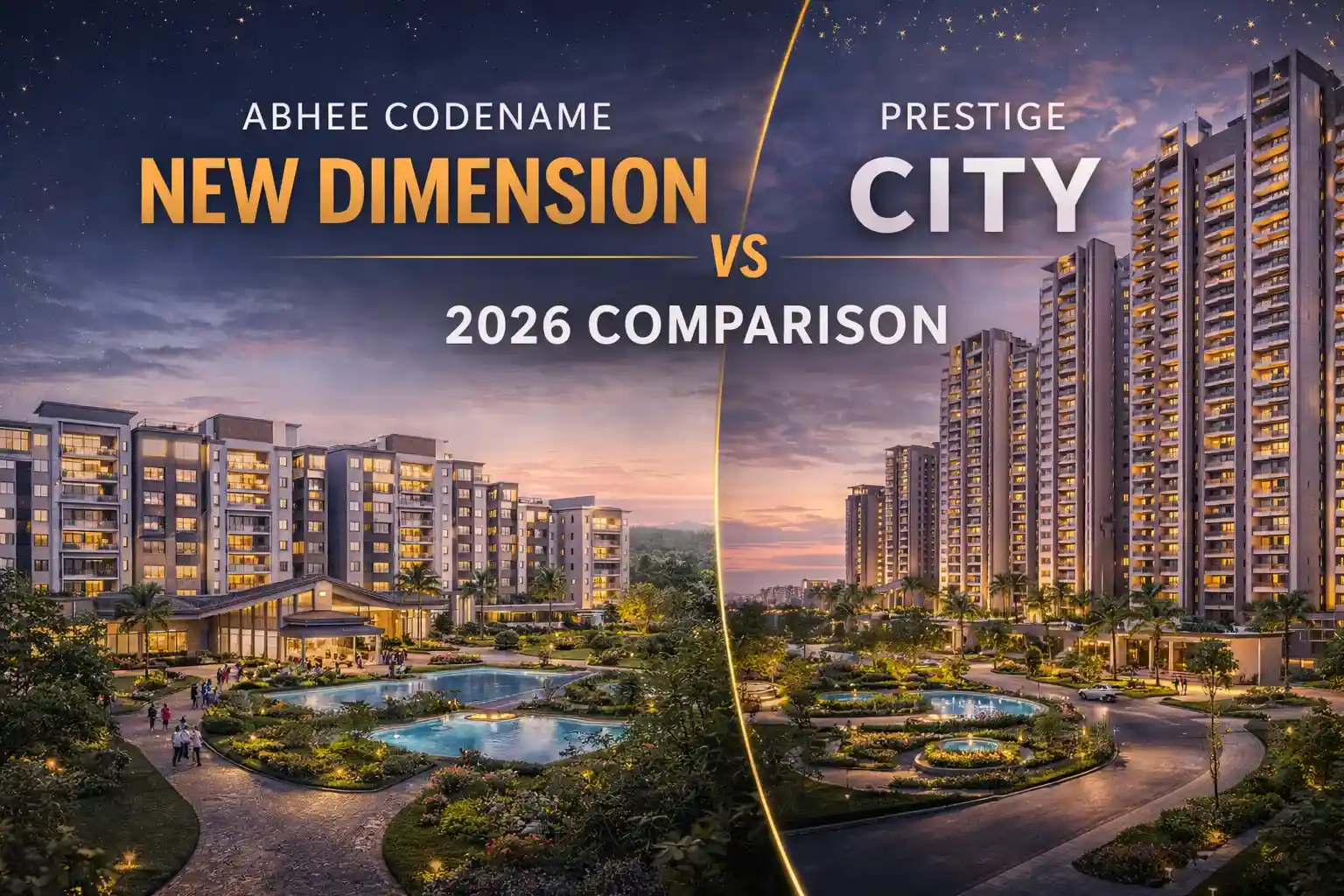
The premium can be partly explained by the golf course, unique themes, and MIVAN quality. Still, a 25% increase over Salarpuria seems quite high. You’re essentially paying for a sense of exclusivity and lifestyle, what that’s worth is really up to you. For more cautious investors, Brigade Orchards (which is ready for possession and priced lower) could be a smarter choice. However, those on the hunt for a unique experience might find the premium justifiable. For a thorough comparison with Prestige City (another premium competitor), don’t miss our head-to-head analysis.
4. Large Township Execution Risk (3,000+ Units)
naging the delivery of over 3,000 apartments across 14 towers at the same time is no small feat. Larger townships come with their own set of challenges:
- Phasing issues: Will all the towers be finished at once, or will some phases, like 1 and 2, be ready while phases 3 and 4 lag behind? The developer hasn’t made it clear which phases will take priority.
- Amenity timelines: The construction of the four clubhouses and the golf course isn’t set in stone. In a worst-case scenario, you might get your apartment in 2029, but the full range of amenities won’t be available until 2030 or 2031. This has been the case in several large townships in Sarjapur.
- Community management: With 3,000 families, managing the residents’ welfare association (RWA) can get complicated, leading to higher maintenance costs (likely around ₹3-4 per sq.ft) and a less intimate community vibe. Some buyers actually prefer smaller communities with 500-800 units.
- Developer’s experience: Abhee has a solid track record with projects over 1,000 units (like Celestial City), and their use of MIVAN technology helps speed up construction. However, be prepared for some initial hiccups in the first year after moving in.
5. Resale Market Uncertainty (Gunjur Micro-Market)
Gunjur’s resale market is on the rise, but it’s still finding its footing. Right now, the resale inventory in this micro-market reveals:
- Average time to sell: 6-9 months (compared to 3-4 months in Whitefield)
- Price discovery is still in progress (with wide bid-ask spreads)
- The buyer pool is smaller (not many walk-in inquiries)
5-year exit strategy
If you’re thinking about selling in 2031 (after possession), you’re banking on Gunjur becoming a sought-after residential area. This seems likely with ongoing infrastructure improvements, but there are no guarantees. While liquidity is expected to get better, it probably won’t reach the levels of Whitefield or Sarjapur Circle micro-markets by 2031.
Who this affects
Short-term flippers (looking to exit in 2-3 years) should steer clear. However, long-term holders (7+ years) are likely to see strong demand as the micro-market develops and infrastructure comes through.
H2: Investment Potential Analysis (Data-Backed)
Let’s get real and set aside the marketing talk to look at the numbers that matter. If you’re considering buying a 3 BHK Luxury apartment (1450 sq.ft) for the current all-in price of ₹1.97 Cr (including all fees as outlined in our breakdown), here’s the financial outlook:
5-Year ROI Projection (2026-2031)
| Parameter | Conservative (8%/yr) | Moderate (10%/yr) | Optimistic (12%/yr) |
|---|---|---|---|
Purchase Price (2026) |
₹1.97 Cr |
₹1.97 Cr |
₹1.97 Cr |
Appreciation Rate |
8% annual |
10% annual |
12% annual |
Property Value (2031) |
₹2.89 Cr |
₹3.17 Cr |
₹3.47 Cr |
Absolute Gain |
₹92 Lakh |
₹1.20 Cr |
₹1.50 Cr |
ROI Percentage |
46.7% |
60.9% |
76.1% |
Assumption Validation: the expected annual appreciation of 8-12% is grounded in a few key factors:
- Historical appreciation along Sarjapur Road shows a 9.2% CAGR from 2018 to 2025.
- Upcoming infrastructure projects like the PRR and Metro Phase 3 are likely to add an extra 1-2% premium.
- There’s a noticeable trend of outperformance in the Gunjur micro-market.
So, the most probable scenario suggests an annual appreciation of around 9-10%, which could bring your investment to between ₹3.05 and ₹3.17 Cr by 2031. That means you’re looking at an absolute gain of ₹1.08-1.20 Cr, translating to a solid 54-60% ROI over five years.
Rental Yield Analysis
Looking ahead to post-possession in 2029, here’s what we can expect for rental income:
- For a 3 BHK, the rental range is between ₹42,000 and ₹50,000 per month.
- This translates to an annual rental income of around ₹5.04 to ₹6.00 lakh.
- The gross rental yield is estimated to be between 2.56% and 3.05%.
- After accounting for maintenance and taxes, the net yield falls between 2.0% and 2.5%.
Tenant Profile
The tenant demographic primarily includes IT professionals from companies like Wipro and Infosys at the Sarjapur campuses, expat families drawn by the nearby schools, and senior management looking for lifestyle amenities. With Greenwood High close by, the vacancy risk is quite low, and we can anticipate an annual occupancy rate of about 10 to 11 months.
Comparison with Alternative Investments (₹1.97 Cr corpus)
| Investment Option | 5-Year Returns | Risk Level | Liquidity |
|---|---|---|---|
Abhee New Dimension |
54-60% (₹1.06-1.18 Cr) |
Medium-High |
Low (2031) |
Fixed Deposits |
36% (₹71 Lakh @ 6.5%) |
Very Low |
High |
Equity Mutual Funds |
60-85% (₹1.18-1.67 Cr @ 12-15% CAGR) |
High |
High |
Gold |
25-35% (₹49-69 Lakh) |
Low-Medium |
High |
Bangalore Real Estate (Avg) |
45-50% (₹89-98 Lakh) |
Medium |
Low-Medium |
A Risk-Adjusted Perspective
When it comes to real estate, you can expect moderate returns, but keep in mind that liquidity is on the lower side. If your goal is to maximize returns and you can handle higher risks, equity mutual funds have historically been the way to go. However, if safety is your priority, fixed deposits (FDs) might be a better fit. Real estate is a smart choice for:
- End-users who are looking for a place to live, not just an investment
- Those wanting to diversify their portfolio with 20-30% in real estate
- Individuals who prefer tangible assets for that emotional sense of security
- Tax benefits, like a ₹1.5 Lakh deduction on the principal and full interest deduction
Who Should Consider Buying Abhee New Dimension?
Ideal Buyer Profile #1: Families with School-Aged Kids
If your kids are between 2 and 8 years old and you’re eyeing Greenwood High, this is a no-brainer. Being just 50 meters away means you could save 10-12 hours a week on commuting. At ₹1.97 Cr all-in, you’re really just paying an extra ₹30-35 Lakh compared to similar projects for this convenience. When you think about it, over a decade of schooling, the time and stress you save make it worth every penny.
Ideal Buyer Profile #2: Long-Term Investors (5+ Year Horizon)
For those investors who can afford to be patient and have a moderate risk tolerance, this is an enticing option. The pre-launch pricing, along with the unique themes and the growth trajectory of the Sarjapur corridor, points to a promising 9-11% annual appreciation. This isn’t a quick flip; it’s a long-term hold until 2032-2034, allowing you to benefit from infrastructure improvements and the development of the micro-market.
Ideal Buyer Profile #3: NRI Buyers (Managed Community Living)
For NRIs looking to retire in Bangalore or relocate their families, here’s what they value:
- A spacious township with all the lifestyle amenities they need (no need to go out)
- A reputable developer with a solid track record (less stress in monitoring progress)
- A golf course and top-notch amenities (focusing on quality of life)
- The possibility of earning rental income during their NRI years (around ₹5-6 Lakh annually)
The Scottish theme is particularly attractive to NRIs from the UK and Europe who appreciate a touch of authenticity.
Ideal Buyer Profile #4: Upgraders from 2BHK (Same Corridor)
If you’re currently living in a 2 BHK in Sarjapur-Whitefield and thinking about moving up to a 3 BHK, staying in the same corridor is a smart choice. It keeps your job stability intact, maintains your social connections, and allows you to stay familiar with the area. Abhee Codename New Dimension provides that upgrade along with a boost in lifestyle- think golf course, more spacious apartments, and top-notch amenities. To get a clear picture of the extra space and additional rooms this upgrade includes, be sure to check out our breakdown of the Abhee New Dimension Floor Plans.
Ideal Buyer Profile #5: Golf Enthusiasts (Lifestyle Focus)
Amateur golfers who are willing to spend a little extra for on-campus golf access will find this appealing. In Bangalore, there are only a few residential golf communities, and country club memberships can cost between ₹8-15 Lakh, often with a 2-3 year wait. Here, you get golf access as part of the deal. If you’re hitting the greens twice a week, the convenience could save you around ₹12-18 Lakh over ten years (considering membership fees and travel time).
If you’re stuck deciding between this and Prestige City, our thorough comparison will guide you on which option suits your budget, urgency for possession, and brand loyalty.
Who Should Skip This Project?
Not Recommended For #1: Immediate Possession Seekers
If you’re aiming to move in by 2026-2027- due to a job transfer, an expiring lease, or your child’s school enrollment- this project isn’t suitable for you. With RERA approval and a construction timeline of 36 months, the earliest you can expect to take possession is December 2029. Avoid the temptation to hope for an early move-in; plan for the entire timeline and include an additional six-month buffer.
Not Recommended For #2: Budget-Conscious Buyers (₹1.5 Cr Max Budget)
With a price of ₹1.97 Cr for a 3 BHK, this option is out of reach for many buyers who have set their budget at ₹1.5 Cr. If you’re on a tight budget, consider these alternatives:
- Brigade Orchards (available for immediate possession, priced between ₹1.35-1.45 Cr for a 3 BHK)
- Salarpuria Misty Charm (starting at ₹1.28 Cr)
- Or you might want to wait for post-launch resales at Abhee (from 2031 onwards, with lower premiums)
Stretching your budget by 30% for those lifestyle perks is only wise if your income is on the rise. Just be careful not to overextend yourself.
Not Recommended For #3: Conservative, Risk-Averse Investors
If the idea of pre-launch uncertainties, RERA approval delays, or construction timeline risks makes you feel anxious, it’s a good idea to stick with ready-to-occupy projects or completed resales. Peace of mind is priceless—those 18-25% pre-launch discounts aren’t worth the stress if you identify as a conservative investor. It’s important to ensure that your personality aligns with your financial goals.
Not Recommended For #4: West Bangalore Daily Commuters
If your office is located in Peenya, Rajajinagar, Yeshwantpur, or anywhere else in West Bangalore, get ready for a commute that can really wear you out. With a one-way distance of 40-50 km and peak-hour travel times of 90-120 minutes, plus monthly fuel costs of ₹8-10K, this lifestyle is tough to maintain. You might want to consider changing jobs to East Bangalore or finding a place closer to work. No amenity package is worth spending 3 hours a day in traffic.
Not Recommended For #5: Short-Term Flippers (2-3 Year Exit Plan)
If you’re thinking about buying in 2026 and selling in 2028 before possession for a quick profit, you might want to reconsider. The Gunjur resale market just doesn’t have the liquidity to support that kind of move. Pre-possession resales typically take about 8-12 months to finalize, and the pool of potential buyers is pretty limited. This kind of strategy might work in places like Whitefield or Sarjapur Circle, but Gunjur isn’t quite there yet. If flipping is your game plan, it’s better to wait until 2028-2029 for the micro-market to really develop.
Expert Verdict (Site Visit Insights)
For anyone researching Abhee Codename New Dimension reviews before deciding, here’s what I learned from two visits I made in March 2026. After spending over four hours visiting two sites (one on March 8 to compare with Prestige City and another on March 10 for a deep dive into Abhee), here’s my honest take:
What Really Stood Out to Me
The quality of the land parcel is top-notch, there are no low-lying areas, no worries about Rajakaluve encroachment, and the title is clean (I double-checked with local land consultants). The 45-acre size is genuine, not exaggerated, I even walked the boundaries myself. The Scottish theme plans presented in the design studio are well thought out, not just for show. I appreciated the developer’s openness in sharing construction timelines, phasing plans, and cost breakdowns—it’s a breath of fresh air since many pre-launch projects tend to keep these details under wraps.
A Realistic Perspective
This project is a premium lifestyle offering aimed at upper-middle-class buyers who prioritize experiences over just financial gains. If your main focus is on return on investment, there are better alternatives out there (like resale options in HSR Layout or pre-launch properties in Whitefield). However, if you’re looking for a home where your family can settle for 8-10 years, and the Scottish theme, golf course, and nearby schools fit your lifestyle, then the premium price makes sense.
My recommendations with a few conditions
Consider buying IF you can check these boxes:
- You can comfortably handle a budget of ₹1.97 Cr (with EMI not exceeding 40% of your monthly income)
- You don’t need to move in before 2030
- You’re either an end-user or a long-term investor (5+ years)
- Your job or lifestyle is based around East Bangalore
- You’ve taken the time to visit the site and confirm the claims
Think twice IF:
- You’re pushing your budget or cutting into your emergency savings
- You need to move in within the next 2-3 years
- You’re only focused on ROI and not considering lifestyle fit
- You haven’t personally checked out the site
Final score: 8.5/10 for the target audience (families focused on lifestyle, long-term investors). 5/10 for conservative investors or those looking for short-term gains.
Final Recommendation
Here’s some practical advice:
- Before you book, take the time to visit the site yourself- check out the 45 acres, look at the last-mile roads, and see how the neighborhood is developing.
- Talk to current residents of Abhee, like those in Celestial City and Nandana Exotica, to get the scoop on delivery timelines and quality.
- It’s wise to consult a financial advisor to make sure your EMI is within 35-40% of your monthly income, without dipping into your emergency funds.
- Download the brochure and verify everything the sales team claims, especially the phasing plans, amenity delivery timelines, and RERA approval status.
- Don’t rush into a decision; compare 3-4 alternatives within your budget. Be sure to check out Brigade Orchards, Prestige City, and Sobha Neopolis before you commit.
Investing ₹2 Cr in a pre-launch project is a big deal, and it’s not something you should rush into. But with this clear assessment, you can make a smart choice that aligns with your financial aspirations and lifestyle needs. If you decide to go for it, I honestly think Abhee Codename New Dimension will be one of the premier residential communities in East Bangalore by 2032. The real question is: Are you the right buyer for this unique opportunity?
After a thorough evaluation, we believe that Abhee Codename New Dimension is worth buying and a great investment for families and long-term investors who appreciate a lifestyle centered around a unique Scottish theme, as well as the promising growth potential of the Sarjapur corridor.
Frequently Asked Questions (FAQs) On Abhee Codename new Dimension Reviews
Q1: Is Abhee New Dimension RERA approved?
As of now, RERA approval is still pending. Abhee Ventures has submitted all the required applications and is aiming for approval by Q3 2026 (September-October). Remember, construction can’t legally begin until RERA registration is complete, so the timeline for possession hinges on that approval. For real-time updates, visit the Karnataka RERA website (rera.karnataka.gov.in) before making your final payment.
Q2: What’s the minimum investment to book a unit?
The entry-level option is a 2 BHK (1050 sq.ft) at a base price of ₹9,650 per sq.ft, which comes to ₹1.01 Cr. Once you add in the PLC (₹150 per sq.ft), club charges (₹3 Lakh), and other costs, you’re looking at a total investment of about ₹1.28-1.32 Cr. The current booking amount for an EOI is ₹2 Lakh, and it’s refundable if RERA approval doesn’t happen. For a complete breakdown of costs, including any hidden charges, take a look at our detailed cost analysis.
Q3: How does Abhee New Dimension measure up against Prestige City in terms of value?
Prestige City provides quicker possession (2027 vs. 2029), a stronger brand reputation, and slightly lower pricing (₹9,200-9,500 per sq.ft). Meanwhile, Abhee New Dimension showcases a unique Scottish theme, an on-campus golf course, and is closer to schools. If you’re on a budget and prefer the Prestige brand, go with Prestige City. But if you’re looking for a unique lifestyle and golf access, Abhee is your best bet.
Q4. What are the hidden costs I should budget for beyond the base price?
Beyond base apartment price, budget for: Preferential Location Charges/PLC (₹100-200 per sq.ft based on floor/view), Floor Rise Charges (₹50-75 per sq.ft for floors 15+), Club Membership (₹3-4 Lakh one-time), Corpus Fund (₹100-150 per sq.ft), Stamp Duty & Registration (7.5% of total cost), GST (5% on construction value), Electricity/Water Deposits (₹50K-75K), and Legal/Processing Fees (₹30-50K). Total hidden costs add 15-18% to base price. A ₹1.40 Cr base apartment becomes ₹1.62-1.65 Cr after these charges.
Q5: Is it easy to secure a home loan for pre-launch projects?
Absolutely, but there are some conditions to keep in mind. Major banks like SBI, HDFC, ICICI, and Axis are willing to provide loans for projects that have RERA approval. Since we’re still waiting on that approval, loan sanctions will only kick in after it’s granted, which we expect to happen around Q3-Q4 of 2026. As for the loan amounts, you can get up to 80% for properties priced under ₹75 Lakh, 75% for those between ₹75 Lakh and ₹2 Cr, and 65-70% for anything above ₹2 Cr. Currently, interest rates are hovering between 8.5% and 9.2%. For a property valued at ₹1.97 Cr, you can expect a loan eligibility of around ₹1.38-1.48 Cr (that’s 70-75% LTV). If you’re looking at a ₹1.40 Cr loan at a 9% interest rate over 20 years, your EMI would be about ₹1.26 Lakh each month. Just a heads up, during the construction phase, your pre-EMI will be lower since it’s interest-only on the amount disbursed.
Q6: What’s the realistic resale potential after 5 years (2031)?
Looking at the historical appreciation in the Sarjapur corridor, which has seen a 9.2% CAGR from 2018 to 2025, along with upcoming infrastructure projects like the Peripheral Ring Road and Metro Phase 3, we can expect an annual appreciation of around 9-11%. So, if you buy a property for ₹1.97 Cr in 2026, it could be worth between ₹3.05-3.25 Cr by 2031, giving you a gain of 55-65%. As for rental yields, you might see around ₹45-52K monthly, translating to a gross yield of 2.7-3.2%. The resale market should get better as the Gunjur micro-market develops, but be prepared for a selling timeline of about 6-8 months, compared to just 3-4 months in Whitefield. If we’re being conservative, you could expect a resale value of around ₹2.95 Cr in 2031, but if everything goes according to plan with the infrastructure, it could even reach ₹3.35 Cr.
Recent Posts
-
Townships vs Apartment Projects: Key Differences in Planning, Lifestyle & Long-Term Value
-
Abhee Celestial City Phase 2
-
Whitefield Sarjapur Road Real Estate Growth Analysis 2026
-
Work-Life Integration in IT Corridors: Living Near Ecospace, RMZ & ITPL in East Bangalore
-
EOI Open for Abhee Codename New Dimension: Price Lock & Priority Before Launch
-
Abhee Codename New Dimension Tentative Launch Date 2026
-
NRI Buyers Guide to Abhee Codename New Dimension